Solar Energy and PV systems – how do they work? Go Back
Author: Marisan Hallett Date: 02 November 2022

Since the birth of the cosmos, the sun has been an eternal source of energy - where solar fuel is constantly being converted into solar energy.
Sunlight consists of a spectrum of wavelengths. Most of the solar energy that reaches the earth’s surface consists of ultraviolet-; visible-; and infrared light. Solar panels are designed to absorb sunlight in the visible wavelengths – the part of the spectrum our eyes can see.
Converting light into energy - the photovoltaic effect
The sun is like a gigantic nuclear reactor that releases particles of light, called photons. These tiny “energy packets” strike the solar cell inside the solar panel, breaking the electrons free from the silicon atom inside. The electrons travel through the electrical circuit created by a semiconductive material.
These electrons produce energy. This is called the photovoltaic effect. The term photovoltaics derives from the Greek word phos meaning light and volt - the unit of electromotive force. Solar power can be characterized as either active or passive, depending on how it captures, converts and distributes solar energy. Active solar energy converts the sun’s energy into usable energy such as electricity from solar panels. Passive energy uses the sun’s natural radiation to help provide heating for example solar water heating.
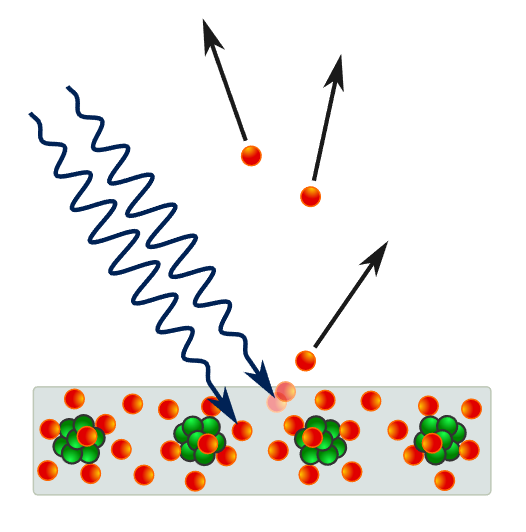
Photons strike the solar cell, breaking the electrons loose, which produce energy.
The Photovoltaic system
The four main components of a photovoltaic (PV) system are the solar panels or modules, inverter, charge controller and monitoring system. There are four main types of PV systems:
-
Back-up system
A back-up system consists of PV modules, an inverter and battery bank. This system will provide power to your home when the grid is not producing energy. Unfortunately, you will only have electricity for a few hours until the batteries’ energy is depleted.
-
Grid-Tied System
The components of a grid-tied system include the PV modules, inverter and monitoring. Electricity produced by the solar panels supplement electricity supplied by the grid. The system is usually sized to match the load during daytime for about six to eight hours a day. However, a grid-tied system is reliant on the grid and will not supply electricity during a power failure or blackout.
-
Off-grid system
Off-grid or standalone systems are where you are not connected to the grid in any way. It consists of PV modules, an inverter, batteries, and a charge controller. It is a self-contained system using batteries to store and give power when the solar panels aren’t active such as during night-time. Power generated by the solar panels is stored in the batteries.
-
Hybrid system
A hybrid system consists of the PV modules, inverter, charge controller, batteries and the energy management system (EMS). Hybrid systems, also referred to as Energy Storage Systems (ESS), combines the best of grid-tied and off-grid solar systems. Hybrid systems are when the solar panels remain connected to the grid, and you have a backup battery system to store excess power. You will always have power no matter the situation.
We have come a long way in our understanding of how we can harness the power of the sun. Solar capacity has grown globally over the past decades, becoming the fastest growing energy generation source. It is abundant, non-polluting and free.
Pic - https://pixabay.com/users/torstensimon-5039407/
Diagram - By Ponor - Own work, CC BY-SA 4.0, https://commons.wikimedia.org/w/index.php?curid=92684859